
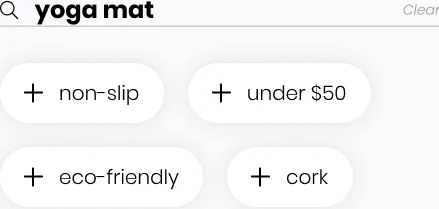
AI Related Tags
Type a couple of words and AI Related Tags appear instantly as clickable refinements, so shoppers can narrow down what they're looking for without having to type another thing.

Conforama Italia, one of Italy's best-known home furnishings retailers, added AI Mode and AI-Assisted Search from Motive Commerce Search to its online shop. Since launch, AI Mode searches have grown by 34%. One in five searches is now a full sentence, and one in three searches that would have returned nothing now leads shoppers to relevant products.
The challenge
A keyword search sees five words. AI Mode sees a room, a problem, and a shopper ready to buy.
Conforama built its brand on choice. It offers a wide range for every room in the home, interior design help, and prices most people can reach. Online, that range is a real strength, but it also makes search harder.
Think about how someone actually shops for a sofa. They're not really looking for "sofa." They want a two-seater under €500 that fits a narrow living room and isn't beige. A traditional search bar can only work with a couple of those details. The shopper has to cut the rest, guess which words the engine understands, and try again when nothing useful comes back.
People used to put up with that. After a couple of years of typing full questions into AI tools everywhere else, many no longer do. They expect the search bar to understand intent and context.
Conforama was already running Motive Commerce Search, so search wasn't broken. The team wanted to make sure the shop was ready for the way its customers were starting to search.
The solution
Conforama added two layers of AI to its search. One lets shoppers have a conversation with the catalogue. The other makes the familiar search bar smarter at every step.
AI Mode is Motive's conversational search experience. Shoppers describe what they want in plain language, and the search answers the way a knowledgeable shop assistant would. It asks follow-up questions, compares options and narrows the results. Chat History keeps the conversation in context, so shoppers can refine what they're looking for without starting again.
For a home furnishings catalogue, this matters because almost every purchase comes with conditions attached, such as room size, budget, style or who will use it. Take a real query from Conforama's search: storage for a small bedroom that doesn't block the window. A keyword engine picks out "storage" and "bedroom" and shows every wardrobe in the catalogue. AI Mode understands that the shopper needs something low and compact, and it shows them that.
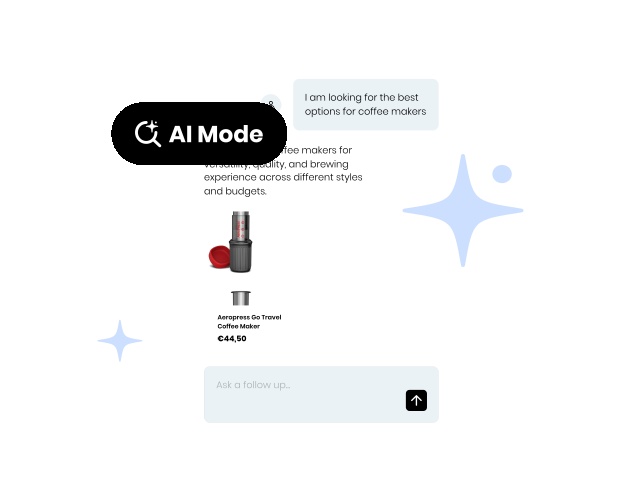
Most shoppers don't start with the perfect search term. They type something broad, scan the results, and only work out what they really want once they see it. AI-Assisted Search is built for that process. It adds an AI layer to the familiar search bar that helps shoppers narrow down, open up, and recover their search without having to find better words themselves.
Type a couple of words and AI Related Tags appear instantly as clickable refinements, so shoppers can narrow down what they're looking for without having to type another thing.

When a search comes up short, Questions AI surfaces smart refinements right alongside results so shoppers can keep narrowing down and find the product they're actually looking for.
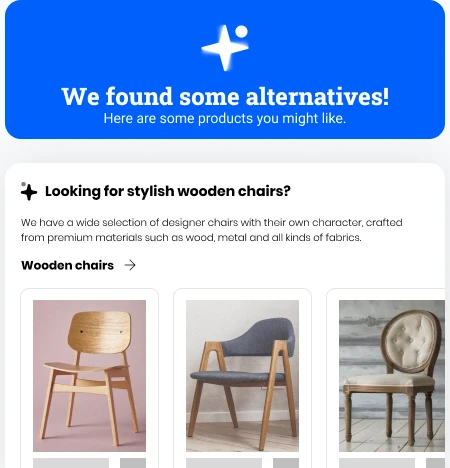
When a search returns no results, an AI Carousel activates automatically to surface products that match what your shopper means, not just what they typed, so there are no dead-ends and no setup needed.
Everything a shopper types into a search bar tells you something valuable: what they want, in their own words, at the moment they're ready to buy.
Many AI search tools send that data to large AI providers, where it can help improve someone else's model. Their pricing also tends to follow the provider's pricing. Both AI layers at Conforama run on Empathy AI's private cloud, independent from OpenAI, Google and Anthropic. Conforama's catalogue data and its shoppers' searches stay with Conforama. The cost stays predictable too, because it doesn't depend on another company's API prices.
The results
82%
82% of AI Mode searches at Conforama are one of a kind. You can't cover that with a synonym list or a set of merchandising rules, because no team could predict those searches in advance. Only search that understands meaning can keep up.
+34%
AI Mode searches have grown 34% since launch, with no one being pushed towards it. More shoppers choose it every month.
20%
Shoppers talk to the shop in natural language because they trust it to understand them. The average query keeps getting longer.
1 in 3
AI-Assisted Search guides shoppers throughout their search. The clearest number Conforama tracks is at the point where most searches fail. One in three searches with no exact match is now rescued and turned back into product discovery, and that rate is still rising.
AI Mode hasn't just improved our search — it's changed how customers discover, plan and buy for their homes. Because it understands intent and context, our search behaves less like a query box and more like a shopping companion. That shows up in engagement, in fewer wasted queries, and in revenue.
Next steps
Your shoppers are probably already typing sentences into your search bar. The question is whether it understands them.
Search is one of the highest-converting moments in any shop, yet it's often left on default settings. When search doesn't understand a shopper, they leave, and you never find out what they came for.
Until recently, AI search like Conforama's was mostly available to large retailers with engineering teams. Motive Commerce Search brings the same AI Mode and AI-Assisted Search to shops of any size.
Installs in minutes on Shopify, WooCommerce, PrestaShop and Magento 2.
You pay by searches, not requests, and your search keeps running even if you go over your plan.
It's never used to train anyone else's model.
30-day free trial. No limits. No plan required upfront.
Start your free trial